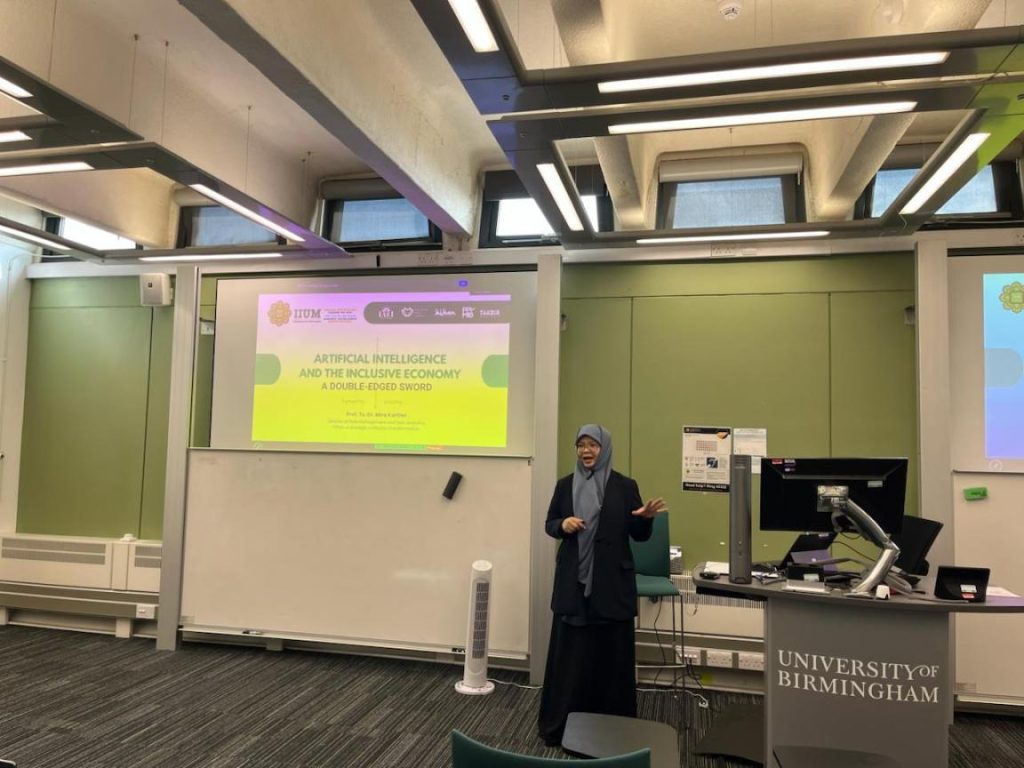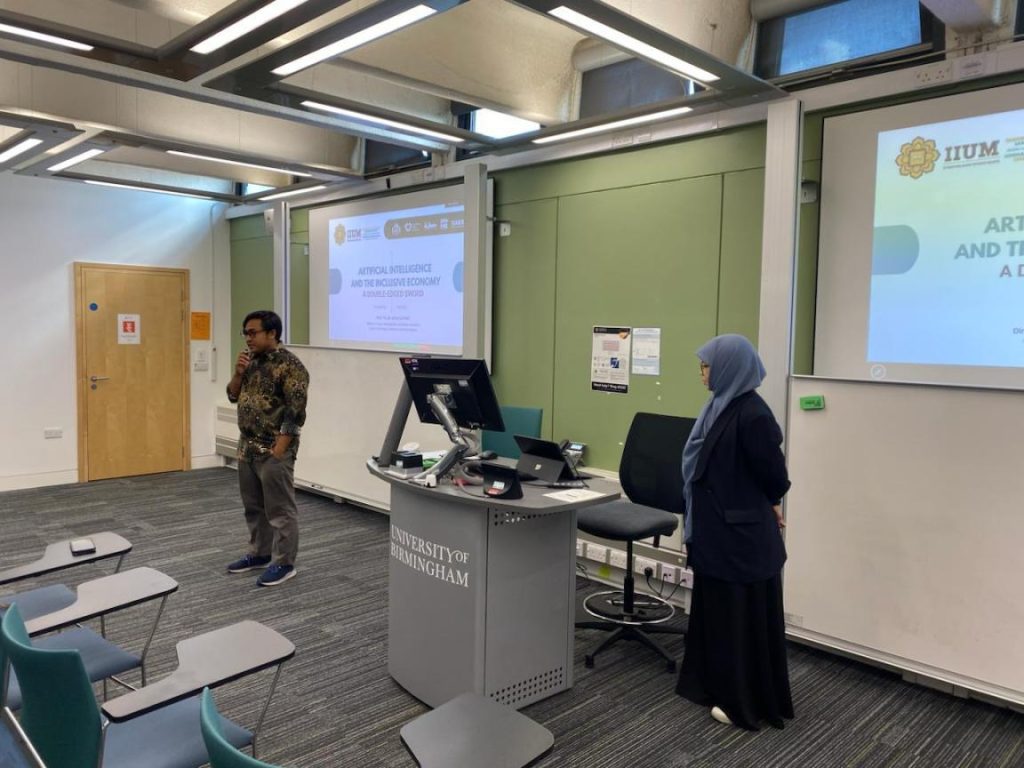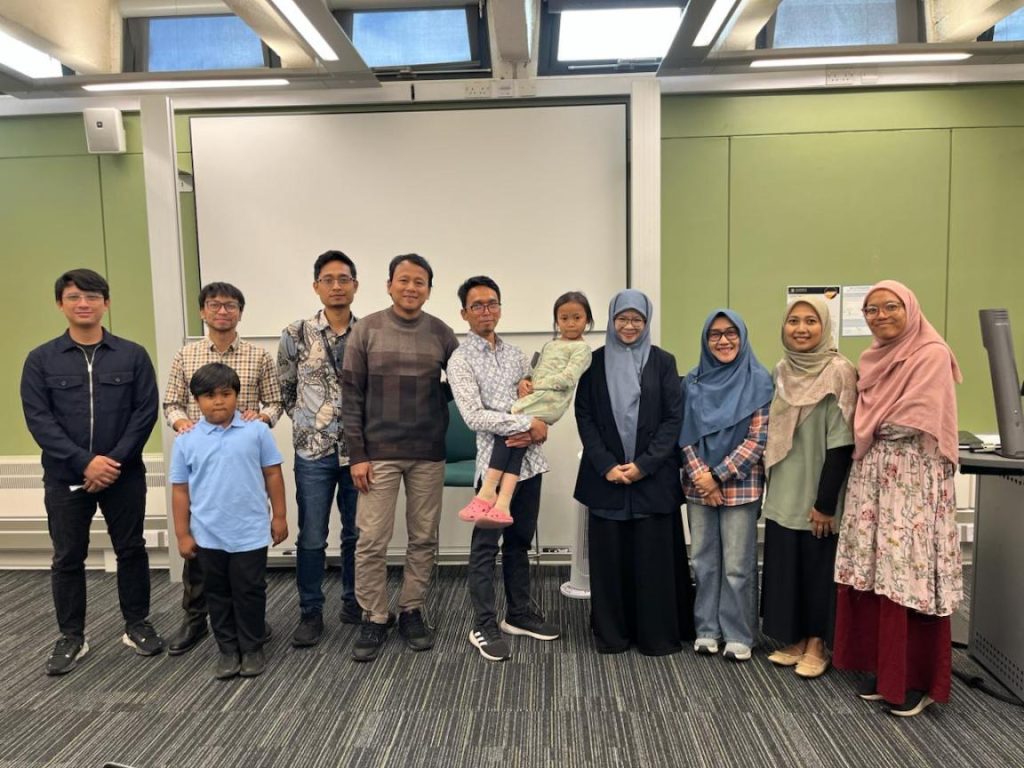
International Madani Association (IMA), together with partner organisations, supported the General Lecture “Artificial Intelligence and the Inclusive Economy: A Double-Edged Sword,” held in hybrid format at the University of Birmingham and online via Zoom.
The session featured Prof. Ts. Dr. Mira Kartiwi of the International Islamic University Malaysia (IIUM), with Dr Wahyu Jatmiko of the University of Southampton as discussant.
The discussion explored how Artificial Intelligence can become both an opportunity and a challenge for an inclusive economy. AI has the potential to increase productivity, widen access to knowledge, improve public services, and strengthen human capabilities. At the same time, it may also displace jobs, increase inequality, reproduce bias, and concentrate technological and economic power.
A key message from the lecture was that AI does not automatically create an inclusive economy. Its impact depends on how governments, institutions, businesses, and communities choose to develop and govern it.
The speakers emphasised the importance of using AI to augment human capabilities rather than simply replace people. This requires stronger skills development, responsible data governance, transparency, public digital infrastructure, and policies that encourage fair access to technological opportunities.
The discussion also highlighted the importance of participation and representation in AI development. Communities should not only be users of technology, but should also have a voice in determining the data, values, and objectives that shape AI systems.
For developing countries and Muslim communities, technological sovereignty was another important theme. Institutions need greater awareness and control over the data, values, and processes behind the technologies they use, particularly when AI is applied to areas such as education, public policy, Islamic finance, and social development.
Ultimately, the discussion reinforced one central principle:
Technology should serve humanity, not the other way around.
The challenge ahead is therefore not only to ask how much productivity AI can create, but also who will benefit from that progress.
Through discussions such as this, IMA continues to encourage constructive engagement with global developments while promoting technology, economic progress, and innovation that remain grounded in human values and the common good.